Nobody Lies at 3 AM: What All-Night Diners and Late-Night Coffee Teach Us About Ourselves
The fluorescent lights are doing nobody any favors. The coffee has probably been sitting in the carafe since 11 PM. The pie under the glass dome is a question you should maybe not ask. And yet — here you are. Here we are. Scattered across the vinyl booths of a 24-hour diner somewhere in America, drinking coffee at an hour that polite society has collectively agreed to spend unconscious.
There's a reason people come here. Several reasons, actually. And almost none of them are about the coffee.
The Geography of Late Night
America's 24-hour diners exist in a particular ecological niche. You'll find them at highway exits, in the middle of cities that never fully quiet down, in the kinds of towns where the Waffle House is the only thing between you and complete darkness. They are, in a very literal sense, the places that stay when everything else goes home.
The clientele after midnight is its own ecosystem. Shift workers stopping in after a hospital or factory stretch. Long-haul truckers on a schedule that has nothing to do with the sun. Insomniacs who gave up on staring at the ceiling around 2:30. College students for whom this is simply dinner. And then — the category that's hardest to name — people who are going through something and needed to be somewhere other than alone with it.
That last group is the one that interests me most.
What Coffee Does When You're Drinking It in the Dark
Coffee at 7 AM is a tool. It's functional, purposeful, pointed at the day ahead. But coffee at 3 AM operates under completely different rules. You're not drinking it to start something. You're drinking it to stay — to remain present in a moment that might otherwise collapse into sleep or despair or the particular void of a phone screen at 2 in the morning.
There's a philosopher's argument to be made that late-night coffee is one of the most honest things we do. You're not performing productivity. You're not networking or brunching or demonstrating your taste in single-origin beans. You're just sitting somewhere warm, with something warm in your hands, trying to figure out what comes next.
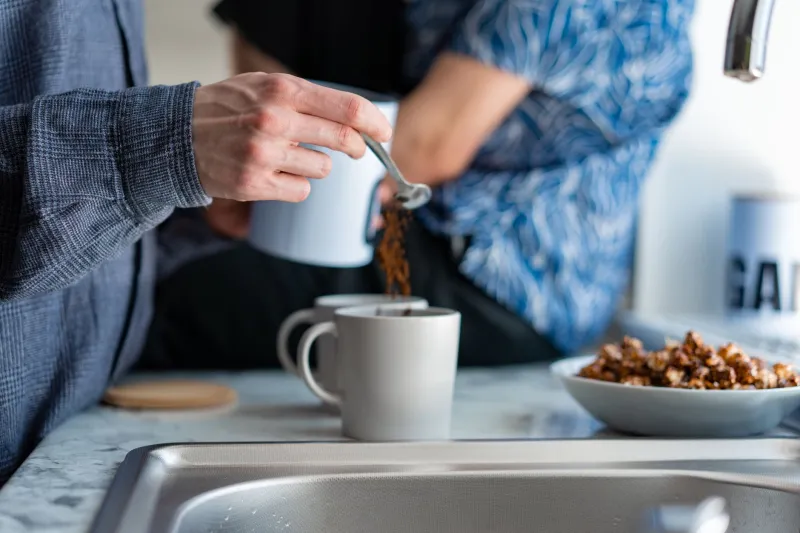
The ceramic mug matters here. Not a paper cup, not a to-go lid — the kind of heavy, slightly chipped mug that a diner fills without asking and refills without charging. It's an invitation to stay. And staying, at 3 AM, is its own kind of courage.
The Conversations That Only Happen After Midnight
Ask anyone who's worked a late-night diner shift, and they'll tell you the same thing: the conversations are different. The usual social armor comes off somewhere around 1 AM. People who would never discuss their divorce or their estranged kid or their fear that they've made all the wrong choices will say those things to a stranger across a diner counter at 3 AM, seemingly without deciding to.
Part of it is exhaustion — the filters we maintain cost energy, and late night depletes the reserves. Part of it is the particular intimacy of a mostly-empty room. When there are only four other people in a space built for sixty, the usual anonymity of public life collapses. You're not invisible. You're just there, together, in the way that people are together in waiting rooms or on long flights — briefly, genuinely, without the scaffolding of context.
And the coffee keeps the conversation going. It gives you something to do with your hands. It marks time in refills. It says I'm not ready to leave yet without making you say it out loud.
Who Goes to the Diner at 3 AM (And Why)
I've been that person more than once. After a breakup, when the apartment felt like it had opinions. After a cross-country move, when the new city was still just a collection of unfamiliar streets and I needed somewhere that felt like somewhere. After a night shift, when the adrenaline of work hadn't finished metabolizing and home felt too quiet.
The diner held me. That's not a metaphor — it's a description of what those spaces actually do. They hold people who need holding without making it weird.
The trucker at the counter has his own version of this. So does the nurse still in scrubs. So does the college kid who just had the fight that might end a friendship. We don't talk to each other, usually. But there's a solidarity in the shared decision to be awake when we don't have to be, to be somewhere rather than nowhere, to be drinking coffee rather than surrendering to the dark.
The Waffle House Theorem and Other American Truths
Waffle House deserves its own paragraph in any honest discussion of late-night American coffee culture. The chain — concentrated in the South but spreading outward like a warm, hash-brown-scented gospel — has become so reliably present during disasters that FEMA has an informal metric called the "Waffle House Index." If the Waffle House is closed, things are genuinely bad. If it's open and serving a full menu, you're going to be okay.
That's not an accident. It's a reflection of what these spaces mean. The 24-hour diner, in all its forms, is a signal that civilization is holding. That there is still light and warmth and coffee available to whoever needs it, regardless of what time the clock says.
In a country that can feel fractured along approximately every possible axis, the late-night diner remains stubbornly, improbably democratic. The booth doesn't care who you voted for. The coffee doesn't ask about your credit score.
Staying Awake on Purpose
Some people go to the 24-hour diner because they have nowhere else to be. But some people go on purpose — specifically, intentionally — because they've figured out that certain kinds of thinking only happen when the rest of the world is asleep.
There's a quality of thought available at 3 AM that isn't accessible at 3 PM. The noise drops away. The to-do list loses its urgency. The questions that get crowded out by daylight — the ones about who you're becoming, what you're actually doing with your life, whether the path you're on still feels like yours — those questions have room to breathe.
The coffee keeps you company while you sit with them. It doesn't rush you toward an answer. It just stays warm for as long as you need it to.
The Cup That Keeps the Light On
Your caffeine destiny, whatever form it takes, probably has a 3 AM chapter somewhere in it. A night when you needed to be somewhere, when the coffee was mediocre and the lighting was unkind and you were more honest with yourself than you'd been in months.
Those chapters matter. Maybe more than the ones that happen in the daylight, surrounded by people who know your name.
The diner will be there when you need it. The coffee will be hot, or close enough. And the mug — heavy, chipped, slightly impersonal — will do exactly what it's always done.
It'll give you somewhere to put your hands while you figure out what comes next.